
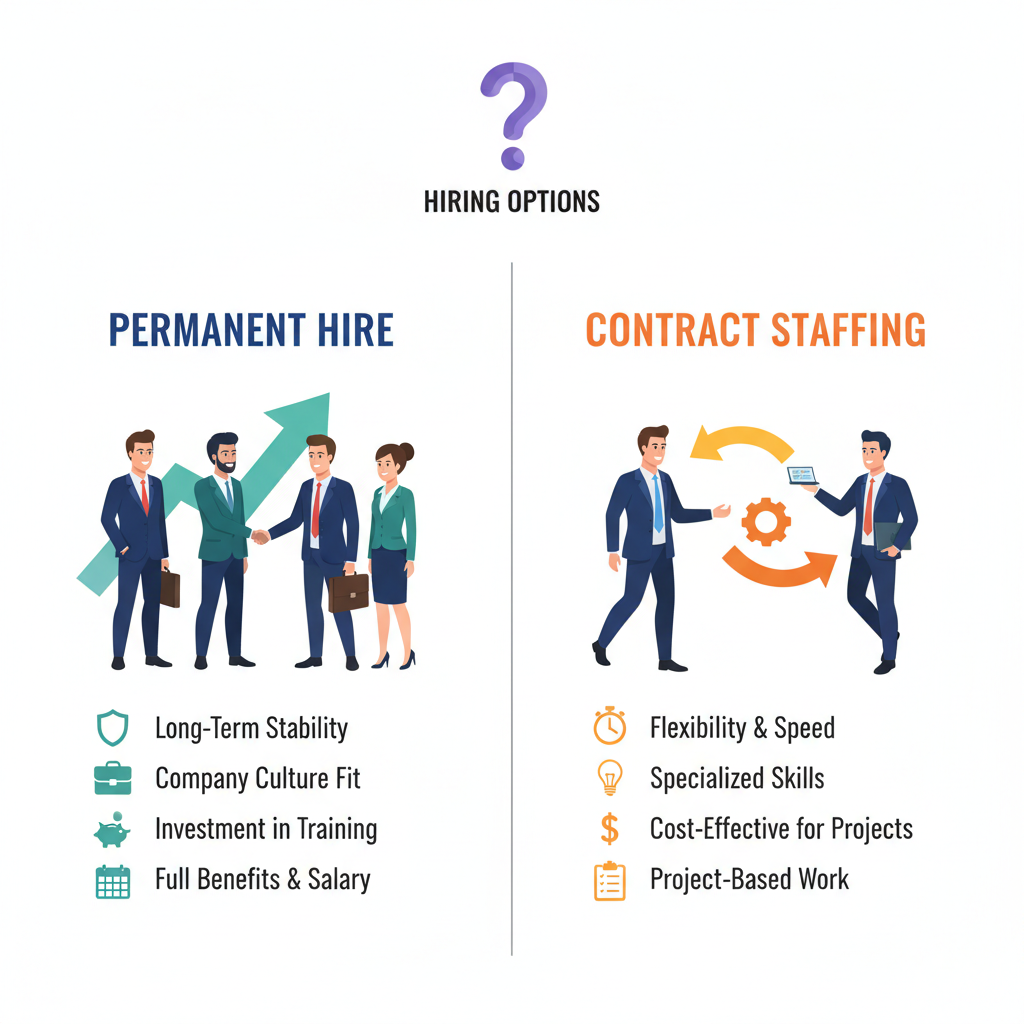
One of the most important workforce decisions businesses face is choosing between contract staffing and permanent hiring. The right approach can significantly impact operational efficiency, workforce flexibility, hiring costs, and long-term business growth.
As markets become more dynamic and project requirements evolve rapidly, organizations are increasingly evaluating alternative workforce models to remain competitive. While permanent employees offer stability and long-term commitment, contract staffing provides flexibility and scalability.
The question is not which model is better overall, but which model is better suited to your business objectives.
This article explores the key differences, advantages, challenges, and use cases of contract staffing and permanent hiring to help businesses make informed workforce decisions.
Understanding Contract Staffing
Contract staffing refers to hiring employees for a specific period, project, or assignment through a staffing partner or workforce solutions provider. Contract employees may work:
- For a fixed duration
- On project-based assignments
- During seasonal demand periods
- For specialized skill requirements
Organizations can quickly deploy talent without making long-term employment commitments.
Contract staffing has become increasingly popular in industries such as:
Understanding Permanent Hiring
Permanent hiring involves recruiting employees who become long-term members of the organization. Permanent employees typically receive:
- Fixed salaries
- Employee benefits
- Career development opportunities
- Long-term employment contracts
This model is often used for positions that are critical to business continuity and strategic growth.
Permanent hiring remains essential for leadership, management, and core operational roles.
Key Differences Between Contract Staffing and Permanent Hiring
Understanding these differences helps businesses choose the right workforce strategy based on operational requirements.
| Factor | Contract Staffing | Permanent Hiring |
|---|---|---|
| Employment Duration | Short-term or project-based | Long-term |
| Workforce Flexibility | High | Limited |
| Hiring Speed | Faster | Slower |
| Employee Benefits | Usually managed by staffing partner | Managed by employer |
| Scalability | Easy to scale up or down | Less flexible |
| Recruitment Costs | Lower upfront costs | Higher recruitment investment |
| Workforce Stability | Moderate | High |
| Long-Term Commitment | No | Yes |
Advantages of Contract Staffing
Here are the key advantages that make contract staffing an attractive workforce strategy for many organizations.
Greater Workforce Flexibility
Businesses often experience fluctuating workforce requirements. Contract staffing enables organizations to:
- Scale teams quickly
- Respond to market demand
- Support short-term projects
- Manage seasonal workloads
Key Benefit
This flexibility is particularly valuable for businesses operating across multiple locations.
Faster Hiring Process
Traditional hiring can take weeks or even months. Contract staffing partners often maintain a ready talent pool, allowing businesses to:
- Fill positions quickly
- Reduce project delays
- Maintain operational continuity
Key Benefit
Speed becomes a competitive advantage during rapid expansion or urgent project requirements.
Lower Recruitment and Administrative Burden
Staffing partners typically manage:
- Candidate sourcing
- Screening and verification
- Payroll administration
- Compliance requirements
Key Benefit
This reduces the workload on internal HR teams and improves operational efficiency.
Cost Optimization
Contract staffing can help businesses reduce costs associated with:
- Recruitment
- Onboarding
- Employee benefits
- Long-term workforce commitments
Key Benefit
Organizations pay for the talent they need without carrying unnecessary workforce expenses.
Access to Specialized Talent
Some projects require niche skills that may not be needed permanently. Contract staffing provides access to experienced professionals for:
- Technical projects
- Field operations
- Surveys and audits
- Infrastructure deployment
- Specialized business initiatives
Key Benefit
This allows businesses to acquire expertise without permanent hiring obligations.
Advantages of Permanent Hiring
Permanent hiring offers distinct advantages that make it the preferred model for many core business functions.
Stronger Organizational Commitment
Permanent employees often develop a deeper connection with the organization. This can lead to:
- Higher loyalty
- Better cultural alignment
- Long-term engagement
Key Benefit
A committed workforce contributes to organizational stability.
Knowledge Retention
Permanent employees accumulate valuable institutional knowledge over time. They develop expertise in:
- Business processes
- Customer relationships
- Company systems
- Organizational culture
Key Benefit
Knowledge retention supports long-term operational success.
Leadership Development
Permanent employees can be developed into future leaders. Organizations can invest in:
- Training programs
- Career development initiatives
- Leadership pipelines
Key Benefit
This strengthens succession planning and organizational resilience.
Greater Team Stability
Stable teams often experience:
- Better collaboration
- Stronger communication
- Higher productivity
Key Benefit
For strategic business functions, workforce continuity is often essential.
When Contract Staffing Is the Better Choice
Contract staffing is ideal when businesses need:
Rapid Expansion
Organizations entering new markets often require quick workforce deployment.
Seasonal Workforce Support
Industries with fluctuating demand can scale resources efficiently.
Project-Based Hiring
Short-term projects benefit from specialized contract talent.
Cost Control
Businesses seeking workforce flexibility without long-term commitments can optimize expenses through contract staffing.
Pan-India Operations
Organizations managing operations across multiple states often rely on staffing partners to deploy talent quickly and efficiently.
When Permanent Hiring Makes More Sense
Permanent hiring is often preferred when:
Building Core Teams
Critical business functions require long-term workforce stability.
Leadership Positions
Management and leadership roles benefit from continuity and organizational knowledge.
Long-Term Growth Plans
Businesses investing in strategic capabilities often prefer permanent employees.
Strong Organizational Culture
Permanent teams help strengthen company culture and employee engagement.
Can Businesses Use Both Models?
Absolutely. Many successful organizations adopt a hybrid workforce strategy.
This approach combines permanent employees for core functions and contract employees for operational flexibility.
Benefits include:
- Improved scalability
- Cost optimization
- Reduced hiring risks
- Faster workforce deployment
Hybrid Strategy
A hybrid model allows businesses to adapt quickly while maintaining organizational stability.
Factors to Consider Before Choosing
Before deciding on a workforce model, businesses should evaluate:
Business Objectives
Are workforce needs short-term or long-term?
Budget Constraints
What level of workforce investment is sustainable?
Growth Plans
Will staffing requirements fluctuate significantly?
Skill Requirements
Are specialized skills required temporarily or permanently?
Operational Complexity
How quickly must talent be deployed?
Answering these questions helps determine the most effective workforce strategy.
The Future of Workforce Management
Modern workforce strategies are evolving rapidly. Organizations are increasingly leveraging:
- Contract staffing
- Workforce outsourcing
- AI-powered workforce planning
- Flexible employment models
- Technology-enabled staffing solutions
The future workforce will be defined by agility, scalability, and data-driven decision-making.
Businesses that embrace workforce flexibility will be better positioned to respond to changing market demands.
Conclusion
Both contract staffing and permanent hiring offer valuable advantages. The right choice depends on your business goals, workforce requirements, and growth strategy.
Contract staffing provides flexibility, faster hiring, and cost optimization, making it ideal for project-based work, rapid expansion, and fluctuating workforce needs. Permanent hiring offers stability, knowledge retention, and long-term organizational development.
For many organizations, a balanced workforce strategy that combines both models delivers the best results.
By aligning workforce decisions with business objectives, companies can improve productivity, control costs, and build a scalable foundation for future growth.